
Technology transfer · Licensing · Acquisition opportunity
Rear-Focus Solar Energy Concentrator Based on an Array of Nested Reflective Rings
Background
Solar technologies often use parabolic mirrors and lenses to focus sunlight onto a receiver which converts sunlight into heat or electricity. Conventional mirrors focus sunlight in front of the collector and require placing the receiver in the incident light path. This creates shading problems, especially with larger receivers, and greatly complicates system construction. Large-area parabolic mirrors also require high-precision, sophisticated support frames to maintain the parabolic shape and resist wind load, which increases the system cost and vulnerability.
Description
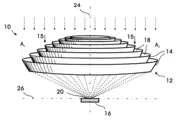
Researchers at Lucent Optics have invented a new type of solar concentrator which uses an array of nested reflective rings to collect and focus sunlight on the rear of the collector with high optical efficiency. The nested ring design requires no secondary optics for its basic operation and ensures that all of the collected energy reaches the receiver with no wasted energy.
The concentrator may range from a few centimeters to dozens of meters in size and can be manufactured by a variety of conventional techniques. Each ring can be designed and even operated independently from the other rings which creates virtually unlimited design opportunities. The optical configuration can be tailored from low to very high concentration (magnification) and also allows for obtaining a very uniform energy distribution in the concentrated beam. The versatility of the ring-array concentrator concept is complemented by dedicated optical modeling and raytracing software which helps simplify and automate the optimal configuration selection process. The spaces between nested rings allow air and elements to pass through the collector with little resistance thus reducing the amount of raw materials and frame members needed to support the structure.
Applications
- Concentrating Solar Power (CSP)
- Concentrating Photovoltaics (CPV)
- Space heating and cooling
- High-heat solar furnaces
- Water purification and desalination
Advantages
- Focus on the rear
- High optical efficiency
- Greatly improved wind resistance
- Lower weight
- Compatible with any receiver types, including fixed and infinite-size absorbers
Patents
United States Patent 6,620,995